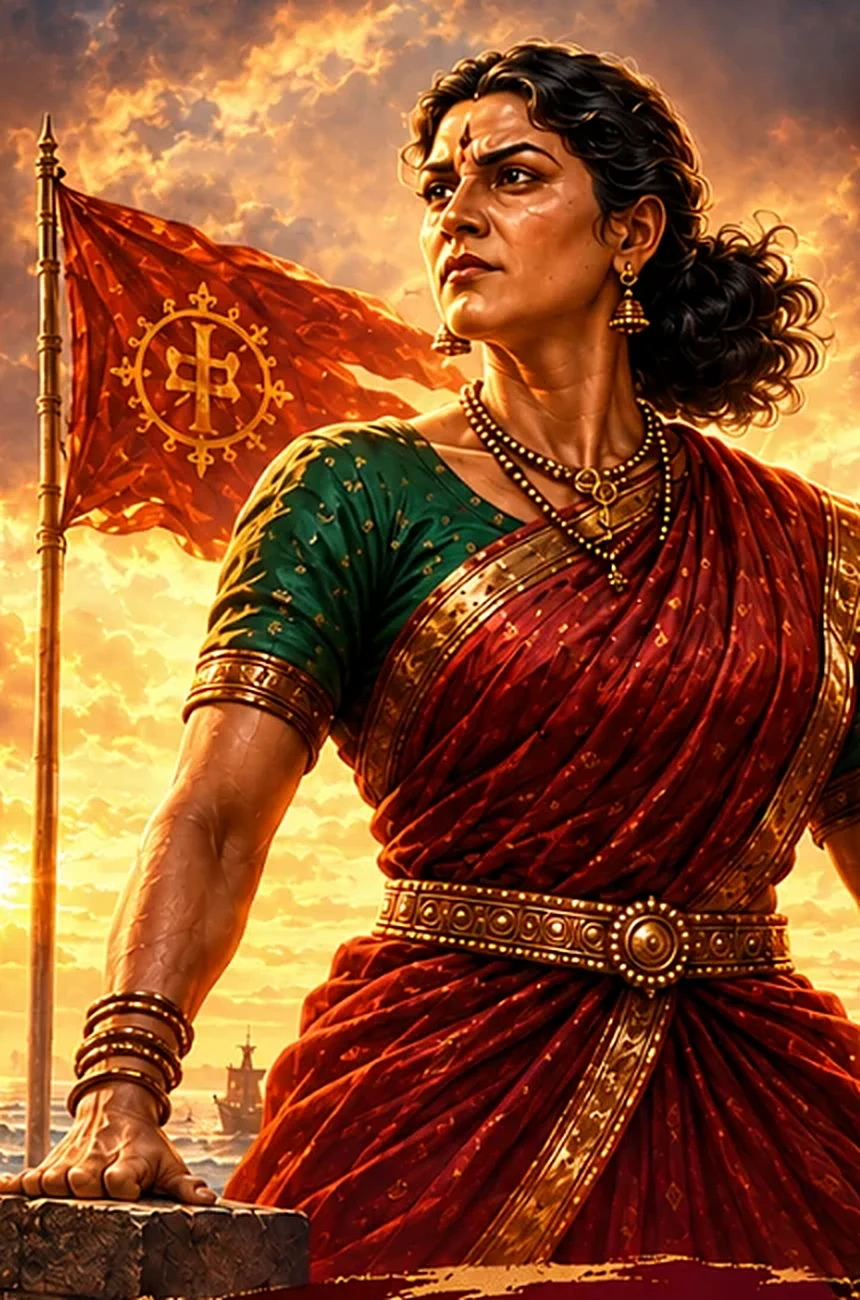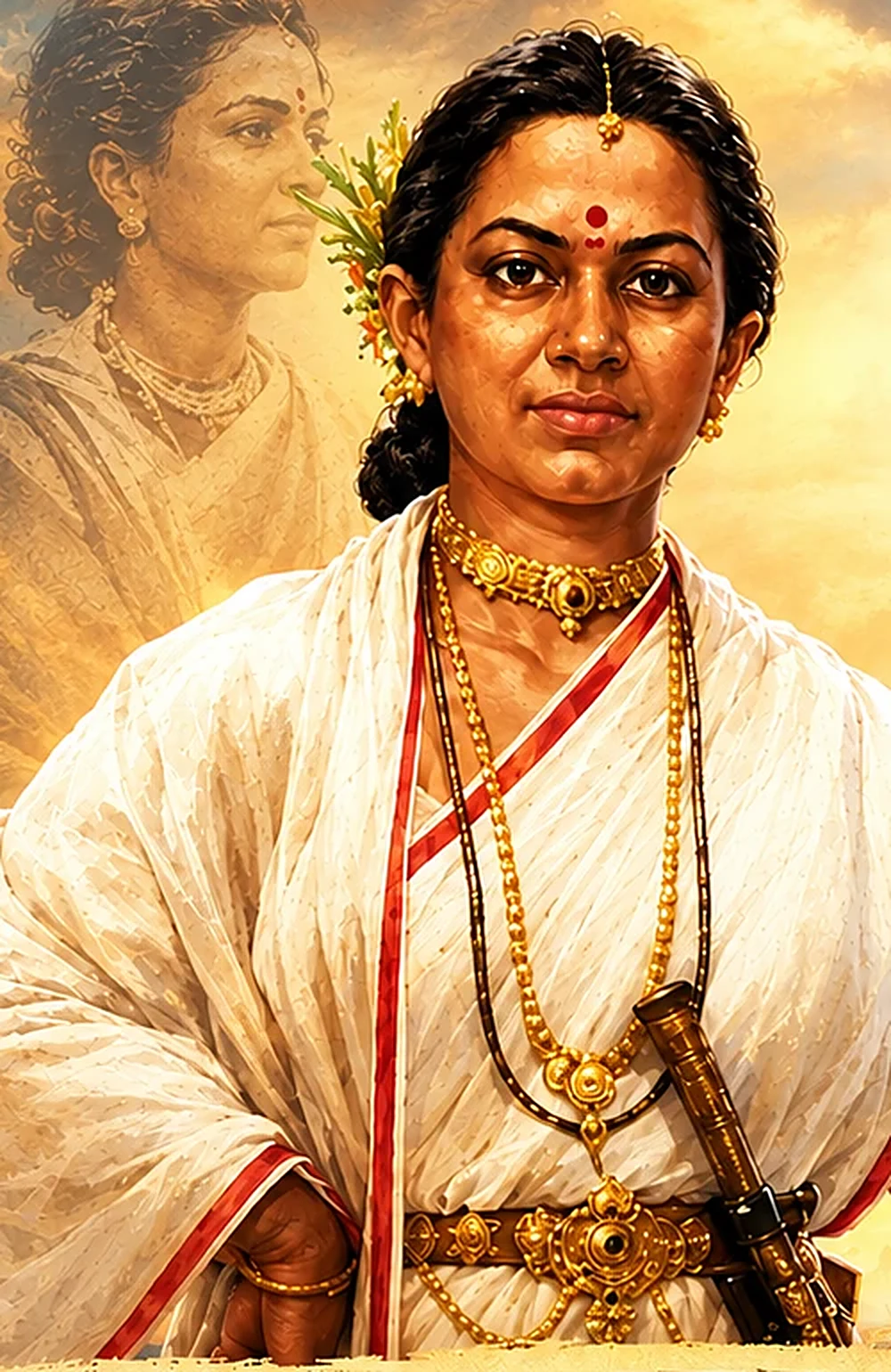
Abhaya Rani — the fearless queen of Ullal, remembered as the first freedom fighter of India.
HOME ✦ RANI ABBAKKA

Rani Abbakka was born around 1525 into the Jain Chowta dynasty of coastal Karnataka (Tulu Nadu). Puttige was the Chowta capital, while the port town of Ullal served as a subsidiary capital. Following the matrilineal Aliyasantana tradition, her uncle Tirumala Raya groomed her for the throne.
She trained in archery, swordsmanship, horse-riding, military strategy and statecraft. Her just and inclusive rule earned the loyalty of Hindus, Jains and Muslims alike — a united coastal community that stood behind her.
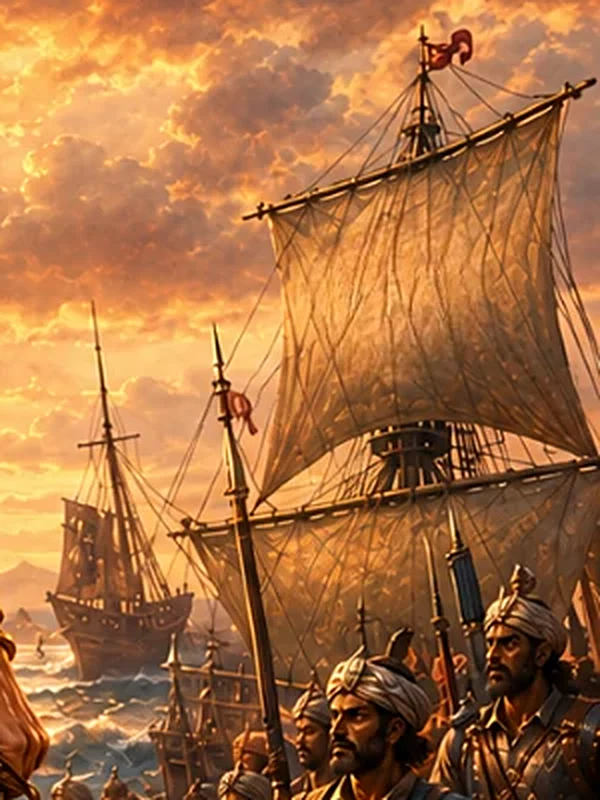
The port of Ullal, the Portuguese fleet, the night of the fire arrows and a queen who never bowed — watch our short film and share it with someone who needs her courage today.
Born into the Chowta family; trained in warfare and governance and became Queen of Ullal.
The Portuguese demanded tribute and she refused. Admiral Dom Álvaro da Silveira's attack on Ullal was driven back.
The Portuguese attacked Mangalore and Ullal again and again; each time Abbakka held her port. In 1567 General João Peixoto's attack was repulsed with heavy Portuguese losses.
She allied with the Zamorin of Calicut and the Bijapur Sultanate so the Portuguese could not gain a lasting foothold on the coast.
Betrayed, she was captured; even in captivity she refused to submit and fought to the last. Her daughters carried on her cause.
Arrows of fire arcing through the night sky — and foreign ships burning on the sea.
Legend holds that Abbakka was the last known warrior to use the Agnivana — fire arrows — setting Portuguese ships ablaze in night raids.
Ullal's port was a vital hub of the spice trade. She spent her life ensuring it never fell under foreign control.
Her story lives on in Yakshagana, folk songs and Bhuta Kola of Tulu Nadu, and in Ullal's annual 'Veera Rani Abbakka Utsav'.
She was among the earliest Indians to resist European colonialism. Her name is carried by an Indian Coast Guard patrol vessel, and she is commemorated with statues and memorials across Karnataka.
Our foundation carries this spirit forward — because there is a little of Abbakka in every woman.

Rani Abbakka Chowta was the 16th-century Jain queen of Ullal in coastal Karnataka (Tulu Nadu), from the Chowta dynasty. She resisted the Portuguese for about four decades and is remembered as one of India's earliest freedom fighters.
She refused to pay tribute to the Portuguese in 1555 and fought European colonial power for decades — nearly three centuries before the uprising of 1857.
Portuguese forces under General João Peixoto captured Ullal. Abbakka escaped, took refuge in a mosque, gathered about 200 fighters and counter-attacked the same night; Peixoto was killed and the Portuguese were driven out.
Agnivana means 'fire arrow'. Legend holds that Rani Abbakka was the last known warrior to use fire arrows, setting Portuguese ships ablaze in night raids.
Through the annual Veera Rani Abbakka Utsava in Ullal, the Indian Coast Guard ship ICGS Rani Abbakka (commissioned 2012), postal covers and stamps, bronze statues in Ullal and Bengaluru, and Yakshagana and folk traditions of Tulu Nadu.
Rani Abbakka Foundation is a registered non-profit in Pune working for women's empowerment, education, self-defence and safety, health, heritage and community service — inspired by Rani Abbakka's courage.